
-
×
 The Science Of Color By Kate Woodman
1 × $8.00
The Science Of Color By Kate Woodman
1 × $8.00 -
×
 The Great Tours: Experiencing Medieval Europe By Kenneth Bartlett
1 × $5.00
The Great Tours: Experiencing Medieval Europe By Kenneth Bartlett
1 × $5.00 -
×
 Delicious Dishes for Every Taste By Bill Briwa
1 × $5.00
Delicious Dishes for Every Taste By Bill Briwa
1 × $5.00 -
×
 Values and Action with Steven Hayes
1 × $8.00
Values and Action with Steven Hayes
1 × $8.00 -
×
 Todd Capital Vending Machine Business Webinar With Affordable Financial Education
1 × $23.00
Todd Capital Vending Machine Business Webinar With Affordable Financial Education
1 × $23.00 -
×
 The Early Middle Ages By Philip Daileader
1 × $5.00
The Early Middle Ages By Philip Daileader
1 × $5.00 -
×
 Become Square Space Web Designer With Pixelhaze Academy
1 × $23.00
Become Square Space Web Designer With Pixelhaze Academy
1 × $23.00 -
×
 Creating Your Hearts Desire 2023 With Sonia Choquette
1 × $23.00
Creating Your Hearts Desire 2023 With Sonia Choquette
1 × $23.00 -
×
 Wellness Warrior Workout By Koya Webb
1 × $6.00
Wellness Warrior Workout By Koya Webb
1 × $6.00 -
×
 Dreaming Yourself Awake by Paul Levy
1 × $46.00
Dreaming Yourself Awake by Paul Levy
1 × $46.00
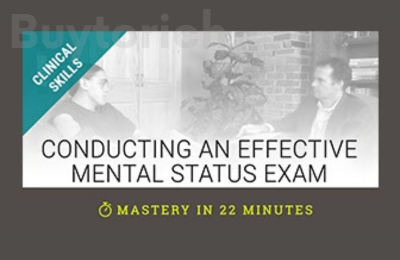
Conducting an Effective Mental Status Exam with John Sommers-Flanagan & Rita Sommers-Flanagan
$8.00
Conducting an Effective Mental Status Exam with John Sommers-Flanagan & Rita Sommers-Flanagan – Immediate Download!
Content Proof:

In the field of mental health, a thorough grasp of a client’s psychological condition can frequently act as the compass that directs therapeutic intervention. A useful tool for mental health practitioners who want to become proficient in the intricate art of assessing mental state is the educational resource Conducting an Effective Mental state Exam, which includes the perspectives of John Sommers-Flanagan and Rita Sommers-Flanagan.
This video resource provides a window into the complexities of doing a Mental Status Examination (MSE) by fusing clinical expertise with useful approaches. Practitioners can create a high-quality encounter that not only reveals important client information but also builds a solid therapeutic alliance—a necessary element of successful treatment—by combining relational tactics, therapeutic listening, and sympathetic participation.
Overview of Mental Status Assessment
The Mental Status Examination provides a detailed picture of a client’s psychological state rather than just a list of symptoms. By showing an enlightening video session with a young client navigating a transitional life phase, the Sommars-Flanagans highlight this idea. Here, the relationship between the physician and the client is very important because it shows how the correct amount of warmth and compassion can turn what may otherwise be a routine exercise into an authentic dialogue that reveals more profound psychological truths. This method focuses on developing trust, which is essential for providing good mental health therapy, rather than only obtaining facts.
Viewers can see firsthand how body language and tone of voice are two examples of subtle clues that have a big impact on the quality of an encounter during the video. This insightful workshop highlights how sympathetic communication techniques might be the key to an effective MSE, proving that listening is a therapeutic activity in and of itself. Through a strategy that promotes cooperation rather than only observation, this resource positions physicians as allies in the process of knowing their clients, not just evaluators.
The main objective of using such sympathetic methods is to make the mental status examination procedure more interesting and less procedural. Clinicians are urged to modify their strategy and manner in accordance to the needs, feelings, and reactions of their clients rather than adhering to a strict framework. This flexibility is essential to establishing a secure environment where customers feel appreciated, heard, and respected.
Key Components of the Mental Status Exam
One of the core contributions of the Sommers-Flanagans lies in their systematic organization of MSE questions into nine specific domains. By structuring the examination in this way, practitioners can ensure a comprehensive assessment while also allowing for flexibility in engagement. Here’s a brief overview of these domains:
- Appearance: Observing how a client presents clothing, grooming, hygiene.
- Behavior: Noting any abnormal movements or behaviors.
- Speech: Assessing tone, volume, and fluency.
- Mood and Affect: Understanding emotional state and how it is expressed.
- Thought Process: Evaluating coherence, logic, and organization of thoughts.
- Thought Content: Identifying any delusions or obsessions.
- Perception: Exploring any hallucinations or sensory distortions.
- Cognition: Testing orientation, memory, and attention.
- Insight and Judgment: Assessing the client’s awareness of their situation and their decision-making ability.
This structured approach facilitates a thorough examination while empowering clinicians to engage more fully with clients. The Sommers-Flanagans advocate for an interactive method, encouraging questions that foster collaboration and invite the client into the conversation. For instance, rather than simply asking, “How are you feeling today?” a better approach might be, “Given the changes you’ve mentioned in your life, what emotions have been most prominent for you lately?”
Improving Cooperation with Customers
Improving the clinician-client relationship is a crucial component of carrying out a successful MSE. Clients are more inclined to give candid and perceptive information when they feel like active partners in their review. Empathetic communication fosters a cooperative spirit and builds a strong therapeutic partnership in addition to improving rapport.
The Sommars-Flanagans employ certain communication techniques that promote discussion. The following are some methods they suggest:
- Reflecting back what clients say in order to affirm their experiences is known as active listening.
- Asking open-ended questions gives clients the freedom to freely express their emotions and ideas.
- Summarizing client responses to make sure they are understood and resonate is known as paraphrasing.
- Empathic Reactions: Providing emotional assistance by acknowledging the feelings of customers.
Clinicians can successfully handle challenging subjects by using these techniques, which gives clients the confidence to open up. This increased comfort can result in deeper understanding of their mental health, which will ultimately help treatment programs be more accurately informed.
The Transformative Role of Empathy in the Therapeutic Alliance
The veneration of empathy in therapy cannot be overstated. The Sommers-Flanagans illustrate that when clinicians approach an MSE with genuine curiosity and warmth, clients are more inclined to open up, moving beyond surface-level discussions. This delicate interplay mirrors a dance where both partners a clinician and client move in sync, guiding one another toward deeper understanding.
Moreover, the emotional resonance established through empathetic engagement can have profound implications for the therapeutic outcome. Research suggests that a strong therapeutic alliance significantly correlates with improved treatment outcomes. For instance, a meta-analysis by Horvath and Symonds (1991) indicated that the quality of the therapeutic alliance can predict client improvement across many therapeutic modalities.
In practical terms, empathy allows clinicians to acknowledge not just the content of what clients are sharing, but also the underlying emotions and fears that may be present. This dual awareness fosters an environment where clients feel genuinely understood, reducing feelings of vulnerability that often accompany mental health struggles. Such an alliance paves the way for meaningful therapeutic exploration and healing.
In conclusion
To sum up, John Sommers-Flanagan and Rita Sommers-Flanagan’s advice on how to perform a successful mental status examination sheds light on the complex dynamics at work in therapeutic partnerships. Practitioners can improve the client experience while effectively assessing psychological functioning by placing an emphasis on empathy, teamwork, and a customized approach to the examination procedure. The educational resource celebrates the significant influence that empathy and understanding have on mental health therapy, going beyond simple clinical tactics. By developing sincere relationships with their clients, mental health practitioners not only obtain important data but also weave the threads of healing and hope into their work.
Incorporating the Sommers-Flanagans’ approaches can greatly empower practitioners to deliver the best care possible while promoting resilience and understanding among clients as the area of mental health continues to develop. In the end, performing a mental status evaluation transforms the process into something more than a technical one, embracing the path to mental health for both the client and the physician.
Frequently Asked Questions:
Business Model Innovation: We use a group buying approach that enables users to split expenses and get discounted access to well-liked courses. Despite worries regarding distribution strategies from content creators, this strategy helps people with low incomes.
Legal Aspects: There are many intricate questions around the legality of our actions. There are no explicit resale restrictions mentioned at the time of purchase, even though we do not have the course developers’ express consent to redistribute their content. This uncertainty gives us the chance to offer reasonably priced instructional materials.
Quality Control: We make certain that every course resource we buy is the exact same as what the authors themselves provide. It’s crucial to realize, nevertheless, that we are not authorized suppliers. Therefore, our products do not consist of:
– Live coaching calls or sessions with the course author.
– Access to exclusive author-controlled groups or portals.
– Membership in private forums.
– Direct email support from the author or their team.
We aim to reduce the cost barrier in education by offering these courses independently, without the premium services available through official channels. We appreciate your understanding of our unique approach.
Be the first to review “Conducting an Effective Mental Status Exam with John Sommers-Flanagan & Rita Sommers-Flanagan”
You must be logged in to post a review.
Related products

Psychology
$389.00

$15.00

$5.00


$69.00

$5.00

$62.00

Psychology
$5.00

Reviews
There are no reviews yet.