
-
×
 Secrets of Internal Power Self Defense Supercharger With David Snyder NLPPower
1 × $85.00
Secrets of Internal Power Self Defense Supercharger With David Snyder NLPPower
1 × $85.00 -
×
 TikTok Ads Mastery 2024 With Chase Chappell
1 × $23.00
TikTok Ads Mastery 2024 With Chase Chappell
1 × $23.00 -
×
 Daygame Instructor Tapes - LifeLoaded
1 × $5.00
Daygame Instructor Tapes - LifeLoaded
1 × $5.00 -
×
 How to Get Over Anyone in Few Days: Breakups Will Never Hurt Like Before (Volume 1)
1 × $5.00
How to Get Over Anyone in Few Days: Breakups Will Never Hurt Like Before (Volume 1)
1 × $5.00 -
×
 Low Content Book Creation Course With Jessica Larrew
1 × $8.00
Low Content Book Creation Course With Jessica Larrew
1 × $8.00 -
×
 The Wavy Language of Vals With CLARISA ARAGON And JONATHAN SAAVEDRA
1 × $39.00
The Wavy Language of Vals With CLARISA ARAGON And JONATHAN SAAVEDRA
1 × $39.00 -
×
 Forecast 2024 Clarification With Larry Williams
1 × $15.00
Forecast 2024 Clarification With Larry Williams
1 × $15.00 -
×
 John Alanis DeluxeBundle
1 × $5.00
John Alanis DeluxeBundle
1 × $5.00 -
×
 Systema Spetsnaz DVD #2 - Spetsnaz Training - World War II - Present Time By Systema Spetsnaz
1 × $15.00
Systema Spetsnaz DVD #2 - Spetsnaz Training - World War II - Present Time By Systema Spetsnaz
1 × $15.00 -
×
 Portraiture Pro Lens FX Flare Overlays by PRO EDU
1 × $8.00
Portraiture Pro Lens FX Flare Overlays by PRO EDU
1 × $8.00 -
×
 Exploring the Cosmic Mind Through Psychedelics With Chris Bache
1 × $15.00
Exploring the Cosmic Mind Through Psychedelics With Chris Bache
1 × $15.00 -
×
 Daygame Podcasts Episodes Collection
1 × $5.00
Daygame Podcasts Episodes Collection
1 × $5.00 -
×
 Quantum Healing With The Energy Codes® With Sue Morter The Shift Network
1 × $23.00
Quantum Healing With The Energy Codes® With Sue Morter The Shift Network
1 × $23.00 -
×
 TREND REV BLOCK AND EA FOREX SYSTEM (No MT4 Indicator) With IFXSuccess
1 × $69.00
TREND REV BLOCK AND EA FOREX SYSTEM (No MT4 Indicator) With IFXSuccess
1 × $69.00 -
×
 Pleasure Principles With Nadine Lee
1 × $69.00
Pleasure Principles With Nadine Lee
1 × $69.00 -
×
 Juicy Relational Skills for Emergence Part 1: The EMERGENCE/SEXUALITY Circuit– Reactivity and Healing With Sarah Peyton
1 × $139.00
Juicy Relational Skills for Emergence Part 1: The EMERGENCE/SEXUALITY Circuit– Reactivity and Healing With Sarah Peyton
1 × $139.00 -
×
 THE UNLIMITED SEX SYSTEM Bunny And FWPB Collab With Fort Worth Playboy
1 × $31.00
THE UNLIMITED SEX SYSTEM Bunny And FWPB Collab With Fort Worth Playboy
1 × $31.00 -
×
 Sinn Teleconference About Dating
1 × $5.00
Sinn Teleconference About Dating
1 × $5.00 -
×
 Purpose Into Profits System With Sherry Watson
1 × $15.00
Purpose Into Profits System With Sherry Watson
1 × $15.00 -
×
 City Scape Retouching For Lightroom and Photoshop by Serge Ramelli
1 × $8.00
City Scape Retouching For Lightroom and Photoshop by Serge Ramelli
1 × $8.00 -
×
 RECRUITING PROFESSIONALS LIVE DIALS With Todd Falcone
1 × $23.00
RECRUITING PROFESSIONALS LIVE DIALS With Todd Falcone
1 × $23.00 -
×
 Same Night Sex Complete System - Super Self Esteem 2 by Vince Kelvin
1 × $5.00
Same Night Sex Complete System - Super Self Esteem 2 by Vince Kelvin
1 × $5.00 -
×
 Human Design Business Cue Cards With Becca Francis
1 × $15.00
Human Design Business Cue Cards With Becca Francis
1 × $15.00 -
×
 Ultra Advanced Sales And Persuasion Strategies With Dan Kennedy
1 × $15.00
Ultra Advanced Sales And Persuasion Strategies With Dan Kennedy
1 × $15.00 -
×
 M.A.P.S. Academy Mastering Automobile Purchasing and Leasing From Home By Deshone
1 × $78.00
M.A.P.S. Academy Mastering Automobile Purchasing and Leasing From Home By Deshone
1 × $78.00 -
×
 Monetize Your Craft By Vickie Howell
1 × $5.00
Monetize Your Craft By Vickie Howell
1 × $5.00 -
×
 Options Trading Workshop On Demand With Affordable Financial Education
1 × $69.00
Options Trading Workshop On Demand With Affordable Financial Education
1 × $69.00 -
×
 Master The Bedroom Program With Apollonia Ponti
1 × $31.00
Master The Bedroom Program With Apollonia Ponti
1 × $31.00 -
×
 The Best Option Trading Course With David Jaffee Best Stock Strategy
1 × $15.00
The Best Option Trading Course With David Jaffee Best Stock Strategy
1 × $15.00 -
×
 How to Prompt ChatGPT in 2024 by Ruben Hassid
1 × $5.00
How to Prompt ChatGPT in 2024 by Ruben Hassid
1 × $5.00 -
×
 The Complete Guide to Multiple Time Frame Analysis & Reading Price Action With Aiman Almansoori - Trading Terminal
1 × $179.00
The Complete Guide to Multiple Time Frame Analysis & Reading Price Action With Aiman Almansoori - Trading Terminal
1 × $179.00 -
×
 Land Investor Accelerator Program With Sumner Healey
1 × $389.00
Land Investor Accelerator Program With Sumner Healey
1 × $389.00 -
×
 Conversational Blueprints: Captain Jack’s Definitive Guide to Get a Beautiful Girlfriend by Captain Jack
1 × $5.00
Conversational Blueprints: Captain Jack’s Definitive Guide to Get a Beautiful Girlfriend by Captain Jack
1 × $5.00 -
×
 Script Builder With Kama Lifestyles
1 × $15.00
Script Builder With Kama Lifestyles
1 × $15.00 -
×
 Trading NQ At The US Open With TradeSmart
1 × $10.00
Trading NQ At The US Open With TradeSmart
1 × $10.00 -
×
 Self-defense by Renzo Gracie
1 × $6.00
Self-defense by Renzo Gracie
1 × $6.00 -
×
 Protecting Your Childs Intuition 2023 With Sonia Choquette
1 × $39.00
Protecting Your Childs Intuition 2023 With Sonia Choquette
1 × $39.00 -
×
 Top Half Guard by Roberto Gordo
1 × $6.00
Top Half Guard by Roberto Gordo
1 × $6.00 -
×
 Crypto Trading Academy With Cheeky Investor
1 × $13.00
Crypto Trading Academy With Cheeky Investor
1 × $13.00 -
×
 Unveil the Power of Your Presence With Deep-Clearing EFT by Mary Sise
1 × $62.00
Unveil the Power of Your Presence With Deep-Clearing EFT by Mary Sise
1 × $62.00 -
×
 The Blueprint And Advanced Blueprint And Anxiety Freedom System And Emotional Eating And Alcohol Training With Matt Gilbert
1 × $46.00
The Blueprint And Advanced Blueprint And Anxiety Freedom System And Emotional Eating And Alcohol Training With Matt Gilbert
1 × $46.00 -
×
 The Connection Course With Joe Hudson
1 × $31.00
The Connection Course With Joe Hudson
1 × $31.00 -
×
 Email Marketing Certification Program With The Smart Blogger
1 × $23.00
Email Marketing Certification Program With The Smart Blogger
1 × $23.00 -
×
 Systema Spetsnaz DVD #5 - Internal Wave Energy By Systema Spetsnaz
1 × $15.00
Systema Spetsnaz DVD #5 - Internal Wave Energy By Systema Spetsnaz
1 × $15.00 -
×
 Teaches Chess With Garry Kasparov MasterClass
1 × $6.00
Teaches Chess With Garry Kasparov MasterClass
1 × $6.00 -
×
 The Illumination Codes Bundle With Unlock Your Design Academy
1 × $54.00
The Illumination Codes Bundle With Unlock Your Design Academy
1 × $54.00
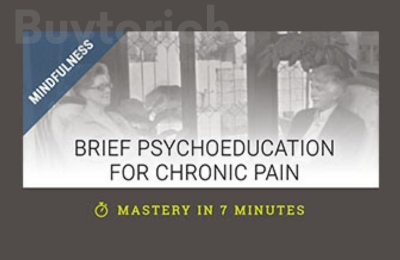
Brief Psychoeducation for Chronic Pain With Ronald D. Siegel
$8.00
Review of Brief Psychoeducation for Chronic Pain with Ronald D. Siegel – Immediate Download!
Content Proof:

Chronic pain frequently casts a pall of pessimism and despair over a person’s life, feeling like an impassable mountain. There is a board of healers, philosophers, and guides in the field of pain management who are looking to the future to find a way through the mists of suffering. In his novel approach to short-term psychoeducation for chronic pain, Ronald D. Siegel integrates the intricacies of the mind, soul, and body into a unified wellness plan.
By emphasizing the integration of mindfulness practices and psychoeducational tools, Siegel facilitates a dialogue that increases patient empowerment and treatment involvement. Siegel provides important insights about how the mind affects the body in situations involving chronic pain through his interactions with Lorraine, a patient dealing with pain from an automobile accident.
An outline of Siegel’s psychoeducational methodology
Siegel’s method of psychoeducation might be compared to shining a flashlight down the shadowy hallways of misinformation and fear that frequently accompany chronic pain. This approach addresses two important topics: how fear affects tense muscles and how worry and pessimistic thinking exacerbate pain perceptions. By changing the narrative from one of powerlessness to one of empowerment, these realizations enable patients to reinterpret how they perceive pain.
- Tension in the muscles and fear
Siegel’s first point is that intense fear can cause muscles to stiffen, which exacerbates pain. The body seems to be trapped in a vice; as anxiety takes hold, the muscles tighten, intensifying the misery in a vicious loop. The necessity of recognizing the mind’s role in pain management is further supported by the way emotions and physiological reactions are intertwined. Numerous studies show that lowering fear-based reactions can result in less tense muscles, which in turn fosters a feeling of relaxation and control. - Focus and Anxiety
Siegel then discusses the relationship between anxiety and pain perception. An increase in anxiety causes attention to be laser-focused on physical discomfort, which amplifies sensations. The pain experience is exacerbated in this area as thoughts descend into a vicious cycle of negativity. In essence, Siegel helps clients move away from the edge of pain-induced despair by assisting them in identifying this spiral and introducing coping mechanisms to refocus attention toward more positive experiences.
This dual viewpoint enables patients to see their pain as a complicated interplay between the body and mind, rather than just an unforgiving enemy, where comprehension can result in profound recovery.
Brief Psychoeducation for Chronic Pain With Ronald D. Siegel
Practical Strategies in the Therapeutic Environment
Incorporating experiential exercises into therapy is a cornerstone of Siegel’s psychoeducational strategy. Just as a craftsman hones his skills with practice, so too can clients develop their coping mechanisms through applied engagement. This makes the therapeutic environment a laboratory for growth.
Experiential Exercises and Mindfulness Techniques
In practice, Siegel employs various techniques designed to enhance awareness, reduce tension, and instill a sense of agency in patients:
- Breathing Exercises: Deep, conscious breathing acts as a bridge connecting the mind and body, helping to open pathways to relaxation even amidst discomfort.
- Mindful Observation: Encouraging patients to observe their pain without judgment can promote detachment from suffering. This is akin to standing on the shore and watching waves crash without being swept away by them.
- Cognitive Restructuring: Helping clients reframe negative thoughts into something more constructive can be transformative. By nurturing a mindset that focuses on healing rather than suffering, patients learn to reclaim their narratives.
These strategies not only enhance engagement but also provide clients with practical tools they can rely on outside the therapy room. Findings from evidence-based studies support the effectiveness of these techniques, validating Siegel’s psychoeducational methods.
The Biopsychosocial Model of Pain Management
Siegel’s work resonates deeply with the biopsychosocial model of pain management, recognizing that chronic pain is a multifaceted condition influenced by biological, psychological, and social factors. This model directly opposes the traditional biomedical approach, which often reduces pain to mere physical symptoms.
Key Components of the Biopsychosocial Model
- Biological Factors: These include the physical aspects of pain, such as injury, inflammation, or nerve damage. Understanding these factors provides a foundation for clinical interventions.
- Psychological Factors: Emotions, thoughts, and mental health play crucial roles in how individuals experience and respond to pain. This is where Siegel’s approach shines, focusing on dismantling fear and anxiety.
- Social Factors: The influence of family dynamics, community support, and cultural perspectives on pain highlights the social context in which chronic pain exists.
By addressing these interconnected factors, healthcare professionals can better tailor their approaches, ensuring comprehensive support for clients on their pain management journeys.
Providing Education to Empower Clients
The focus on empowerment in Siegel’s psychoeducation is among its most potent features. Education gives people the knowledge they need to address their pain holistically because knowledge is like light in the dark. Clients become active partners in their treatment when using this method.
Psychoeducation’s advantages.
- Improved Self-Awareness: Patients get an understanding of the psychological aspects of their pain experiences, which enables them to have more intelligent discussions with their medical professionals.
- Enhanced Motivation: Clients are more driven to participate in their treatment as they understand how thoughts, feelings, and bodily sensations interact, turning inertia into action.
- Better Coping Ability: Clients who are equipped with coping mechanisms and mindfulness practices are better able to manage their discomfort and experience less distress.
Thus, Siegel’s work is like a road map through a thick forest; it provides crucial direction that empowers patients to navigate the complexities of chronic pain on their own.
In conclusion,
One example of the possibility of integrated care that takes into consideration the mind, body, and social environment is Ronald D. Siegel’s brief psychoeducational approach to addressing chronic pain. In order to help clients and medical professionals navigate the frequently turbulent waters of chronic pain management, Siegel acknowledges the intricate interactions between fear, anxiety, and the biological aspects of pain. By means of instruction, awareness, and active participation, patients are enabled to recover their stories and create paths to recovery. His approach thus serves as a ray of hope and a reminder that despite the challenges posed by chronic pain, there are significant opportunities for development and fortitude.
Brief Psychoeducation for Chronic Pain With Ronald D. Siegel
Frequently Asked Questions:
Business Model Innovation: We use a group buying approach that enables users to split expenses and get discounted access to well-liked courses. Despite worries regarding distribution strategies from content creators, this strategy helps people with low incomes.
Legal Aspects: There are many intricate questions around the legality of our actions. There are no explicit resale restrictions mentioned at the time of purchase, even though we do not have the course developers’ express consent to redistribute their content. This uncertainty gives us the chance to offer reasonably priced instructional materials.
Quality Control: We make certain that every course resource we buy is the exact same as what the authors themselves provide. It’s crucial to realize, nevertheless, that we are not authorized suppliers. Therefore, our products do not consist of:
– Live coaching calls or sessions with the course author.
– Access to exclusive author-controlled groups or portals.
– Membership in private forums.
– Direct email support from the author or their team.
We aim to reduce the cost barrier in education by offering these courses independently, without the premium services available through official channels. We appreciate your understanding of our unique approach.
Be the first to review “Brief Psychoeducation for Chronic Pain With Ronald D. Siegel”
You must be logged in to post a review.
Related products

Psychology
$5.00
$15.00

$62.00

$8.00


$233.00

Psychology
$46.00

$8.00

$5.00
Reviews
There are no reviews yet.